

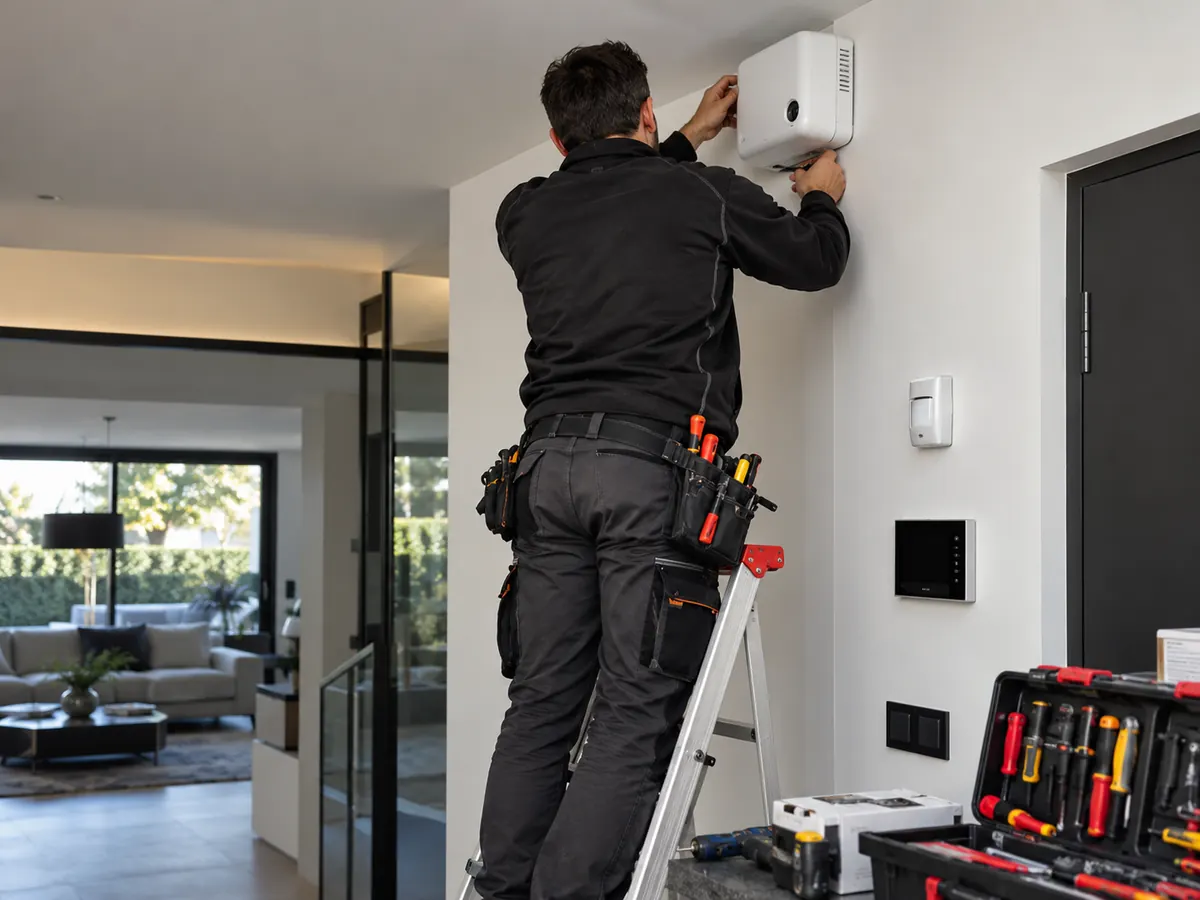
16 Nov What is a motion detector and how it works in an alarm
What is a motion detector and how it works in an alarm
Knowing what a motion detector is helps you understand why an alarm detects an intruder even if no door has been forced. It is the sensor that watches the inside, or the outside, of an area and alerts the control panel when someone moves through it. Together with the magnetic contacts on doors and windows, it forms the basis of almost any alarm system in homes and businesses. In this guide we explain how it works, which types there are and where it is best placed so that it detects well without causing false alarms.
VIAN SEGUR guide · Detectors
The sensor that detects the intruder once they are inside
A good detector does not depend only on its technology: its location, its adjustment and the way each room is used decide whether it works well. That is why at VIAN SEGUR we study the property before choosing and placing each device.

Since 1989
Experience in security systems
Assigned technician
Follow-up and maintenance

GSM / LAN
Dual-path communication

Remote management
Control and alerts from your phone

What is a motion detector
A motion detector is a device that watches a space and generates a signal when it senses that someone is moving through it. That signal reaches the alarm control panel, which interprets it according to how the system is armed: if the zone is protected, the alarm is triggered, the siren sounds and the alert is sent to the user or to the receiving centre.
In the industry it is also called a volumetric detector, because it does not protect a specific point, as a contact on a door does, but a volume: a room, a corridor or a through-route. That is why it is the system's second barrier. If someone gets in without opening a protected door, for example by breaking glass, the detector discovers them as they move through the interior.
So when someone asks what protects a house better, contacts or detectors, the answer is that they complement each other. Contacts raise the alert as soon as an entrance is opened and detectors confirm whether there is someone inside, which gives the system and the receiving centre more information to decide how to act.
What exactly it detects
Most detectors do not see the person the way a camera would. They measure changes in the environment, such as the body's heat radiation or the reflection of a signal, and decide whether that change corresponds to someone moving through the area.
Where it fits within the system
The control panel, keypads, siren and communications complete the set. Magnetic contacts protect the entrances and motion detectors cover the interior, so that the system raises the alert both if an entrance is opened and if someone is already inside.
How a motion sensor works
Each technology detects in a different way and has its strengths. Knowing them helps you understand why the same device is not installed in a living room, a storeroom or a garden.
All of them share one idea: the detector does not raise the alert for any change, but when that change resembles that of a person moving. The better that criterion is adjusted to the room, the fewer false alarms there are and the more reliable the real detection is.
Passive infrared (PIR)
It is the most widespread. It detects the infrared radiation emitted by the human body and triggers when a heat source crosses the zones of its field of view. It is reliable, uses little power and works well indoors, although it is affected by heat sources that change abruptly, such as a radiator or direct sunlight.
Microwave
It emits a signal and analyses how it bounces back from the environment. If something moves, the reflection changes and the detector registers it. It has a longer range than a PIR, but it can pick up movement through some materials, so it needs careful adjustment.
Dual technology
It combines infrared and microwave, and only raises the alert when both technologies detect at the same time. This greatly reduces false alarms in spaces with draughts, temperature changes or machinery, such as storerooms, garages or shops.
Types of detectors according to where they are installed
Besides the technology, the detector is chosen for the place where it will work. Covering a whole room is not the same as protecting a large window or a garden.
In most homes and businesses several types are combined. A flat may need volumetric detectors in the living room and corridor and a curtain detector on the terrace, while a detached house adds outdoor detectors in the garden to raise the alert before anyone reaches the façade.
Indoor volumetric
They cover rooms, living rooms, corridors and through-routes. They are normally placed in a high corner to cover the room and are the most used in flats, offices and shops.
Curtain
They create a narrow barrier in front of a window, a large window or a sliding door. They allow you to be at home with the alarm partially armed and to detect if someone tries to enter through that point.
Outdoor
They protect gardens, patios, porches and façades. They are the basis of perimeter protection, which detects the intruder before they reach the home. They are adjusted for pets, vegetation and environmental conditions.
With camera
They incorporate a camera that takes images when the detector is triggered, so that the alert can be verified. This is the idea on which an alarm with a camera is based.

Comparison of motion detectors
This table summarises the practical differences between the most common detectors. It is a general reference: the final choice depends on the space, the risk and daily use.
Detector type
Where it is used
What it provides
Passive infrared (PIR)
Living rooms, bedrooms, corridors and offices
Reliable detection and low power consumption
Dual technology
Storerooms, garages and premises with draughts or temperature changes
Fewer false alarms
Curtain
Windows, large windows and sliding doors
Protection of the entrance while the home is occupied
Outdoor
Gardens, patios, porches and façades
Alert before the intruder gets in
With camera
Areas where verifying the alert is important
An image of the moment of triggering
A better detector does not make up for a poor location. A PIR well placed on an intruder's unavoidable route is usually more effective than a more expensive device badly aimed.
Where to place a motion detector
Location is as important as technology. The aim is to cover the routes someone would have to take to reach what they want to carry off, without the detector seeing heat sources or movement that are not people.
Unavoidable routes
Corridors, hallways, the entrance to the living room or the access to the till area are almost inevitable points of passage. A detector well oriented towards them discovers the intruder even if they entered at an unexpected point.
What to avoid
Pointing at windows in direct sunlight, radiators, air conditioners or fireplaces, and placing tall furniture or curtains that block the field of view. These are the most common causes of false alarms and uncovered zones.
Homes with pets
Detectors can be configured and positioned to reduce false alarms caused by animals. We assess it during the visit according to the size of the pet, the areas it moves through and whether it climbs on sofas or furniture.
How to avoid false alarms
A false alarm is not just a nuisance. If it keeps happening, the user ends up leaving the system unarmed and the home or business is left unprotected just when it is needed most. Most have a solution with a good choice of equipment, correct adjustment and simple use.
Knowing the keypad and the app avoids a good share of the problems: leaving with enough exit time, knowing how to activate partial arming and being clear about which zones are protected in each mode. We explain it when we hand over the installation and your assigned technician resolves any question afterwards.
Adjusting sensitivity and range
Each detector is programmed according to the size of the room and what is in it. Excessive range in a narrow corridor or high sensitivity next to a window generate alerts that do not correspond to any intrusion.
Technology suited to each space
In storerooms, garages or premises with draughts, dual technology filters changes in the environment much better. Outdoors, detectors designed for wind, rain, vegetation and animals are used.
Verification of the alert
When the system is connected to an ARC, audio or image verification makes it possible to rule out false alarms before notifying the security forces or the contact persons.
Detector maintenance
A detector that worked on day one can stop working well over time. Dust on the lens, a drained cell, a new piece of furniture or a change in the layout of the room affect detection without the user noticing. That is why annual maintenance checks detectors, batteries and communications, and it is advisable to tell the company if you change doors, windows or the layout of the property, because a detector may need to be moved.
How VIAN SEGUR chooses the detectors for each installation
We do not sell closed kits: we decide how many detectors are needed, of what type and where, after seeing the property.
01
Study of the property
We review entrances, windows, rooms, interior routes and outdoor areas before choosing equipment.
02
Choice of detector
We choose technology and type according to each space: indoor, curtain, outdoor or with camera.
03
Installation and adjustment
A technician and an engineer place, aim and programme each detector according to the real use of the room.
04
Maintenance
Your assigned technician checks detectors, batteries and communications at the annual check-up.
How many detectors does your home or business need?
We review the property, the entrances and the way each room is used to propose just the right detectors, well placed and without false alarms.
Common mistakes with motion detectors
Aiming the detector at a window in direct sunlight or at a radiator.
Blocking its field of view with shelves, curtains or tall furniture.
Protecting only the rooms and forgetting corridors and through-routes.
Not taking pets into account when choosing and placing detectors.
Mixing detectors of different grades: the system takes the grade of the lowest one.
Moving furniture or refurbishing without telling the company so the location can be reviewed.
Frequently asked questions about motion detectors
What is a motion detector?
It is a sensor that detects the presence of a person moving through a protected area and sends a signal to the alarm control panel so that it raises the alert.
What is the difference between a motion detector and a magnetic contact?
The magnetic contact raises the alert when a door or window is opened. The motion detector protects the interior and alerts if someone moves through the room, even if they entered another way.
Does a motion detector detect through walls?
Infrared ones do not. Microwave ones can pick up movement through some materials, which is why they are adjusted carefully or combined with infrared in dual-technology models.
Will the alarm go off because of my dog or cat?
Detectors can be configured and positioned to reduce false alarms caused by pets. We study it during the visit according to the animal and the home.
Can I leave the alarm armed while I am at home?
Yes, with partial arming. For example, the curtain detectors and those on the ground floor are activated and the bedrooms are left unarmed.
Do wireless detectors work just as well?
Yes, if they are certified and well positioned. They run on cells, so it is advisable to check them at the annual maintenance.
Request a security assessment for your home or business
At VIAN SEGUR we review entrances, rooms and routes to decide which detectors you need and where to place them, with an assigned technician for maintenance. Find out about our alarm systems as well.
Request a security assessment
No Comments