

Alarm for shops in Madrid: tailor-made protection for your store
A shop alarm in Madrid has to protect much more than the front door. Shop windows, metal shutters, rear entrances, stockrooms, the till area and the hours when the premises are empty are the points that decide whether a store is properly protected. At VIAN SEGUR we design systems for neighbourhood shops, fashion stores, opticians, tobacconists, electronics stores, bakeries, hair salons and any street-level business, adapting the installation to the real risk of the activity.
VIAN SEGUR · Security for shops
Protect your store when it is open and, above all, when it is closed
Most shop burglaries happen at night or at weekends, when the premises are empty. A professional system connected to an Alarm Receiving Centre (ARC), with dual GSM/LAN communication and video verification, lets you react within minutes and alert the police when the intrusion is confirmed.

Since 1989
Experience in security systems
Assigned technician
Follow-up and maintenance

GSM / LAN
Dual communication path

Remote management
Control and alerts from your phone
What makes a shop alarm different
A shop is not used like a home. People come and go all day, goods are on display, there is cash in the till and, often, a stockroom with a separate entrance. On top of that, the business usually closes at the same time every day, something intruders watch for.
That is why a shop alarm must combine fast detection, reliable verification and communication that does not depend only on the premises' internet line.
Entrances and façade
Main door, metal shutter, shop windows and rear or hallway access points. These are the most exposed points and should raise the alarm before the intruder gets inside.
Goods, till and stockroom
Zoning lets you protect the stockroom or back shop while customers are being served, and give a higher level of protection to areas holding valuable stock.
Opening hours and users
Each employee can have their own code and schedule. This way you know who arms and disarms the system, and forgotten closings are avoided.

Detection and verification: the two keys to the system
Detection has to be early: contacts on doors and shutters, glass-break detectors on shop windows and motion detectors inside. The sooner the attempt is detected, the more time there is to react.
Verification is what allows the alarm receiving centre to confirm that the alarm is real before alerting the police. It can be done through sequential detection, audio or video. In shops, image verification with CCTV cameras is especially useful because it also records what happened.
Shop windows and glass
Breaking glass is a common way of getting into shops. Glass-break detectors and contacts on the shutter raise the alarm at the perimeter, before the goods are reached.
Wall breaches and access from adjoining premises
In some shops it is worth protecting party walls, ceilings or access from hallways and neighbouring premises with seismic detection or well-aimed interior detection.
Solutions for shops with valuable goods
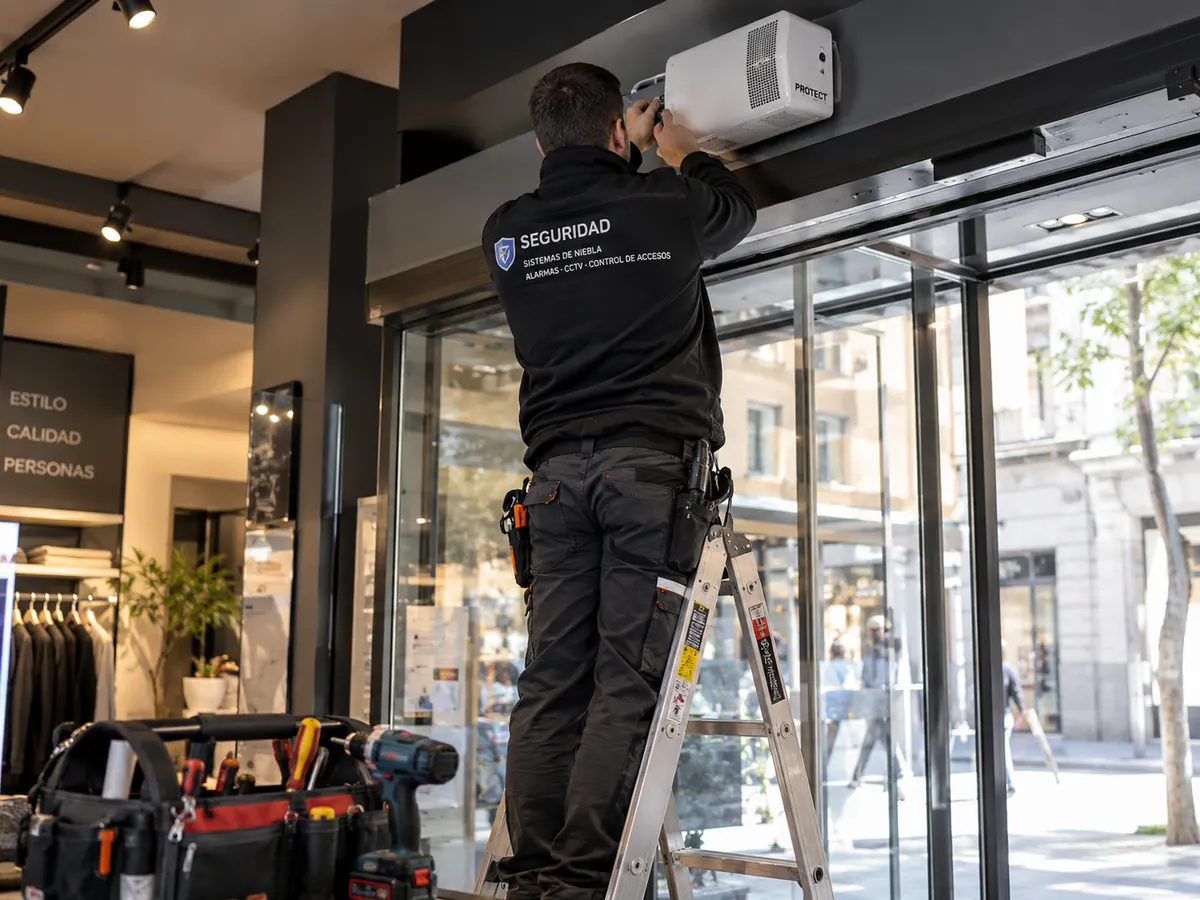
In some shops a few minutes are enough to take a large part of the stock: electronics, mobile phones, perfumery, opticians or high-end fashion. In these cases, in addition to the alarm, a fog alarm can make sense: on a valid activation, the fog fills the premises in seconds and leaves the intruder with no visibility.
If the activity is among the establishments required by private security regulations, such as jewellers or lottery administration offices, the system must comply with Grade 3 and specific requirements. We review this in the preliminary assessment.
Neighbourhood shops
Bakeries, greengrocers, hair salons or stationers usually need a well-designed Grade 2 alarm, connected to an ARC and easy to arm when closing.
Shops with high-value stock
Consider security fog, CCTV with verification, stockroom protection and redundant communications.

How we install a shop alarm
The process is designed not to interrupt the business and to leave a system that is easy for the whole team to use.
01
Site visit
We review the façade, shutters, shop windows, stockroom, till, secondary access points and opening hours.
02
Tailor-made proposal
We define zones, devices, security grade and communications according to the activity and the goods.
03
Installation
We install outside opening hours when necessary and set up users and codes for each employee.
04
Maintenance
An assigned technician carries out the annual review and adapts the system if the premises or the activity change.
ARC connection and police alert
With the alarm connected to an Alarm Receiving Centre, signals are handled 24 hours a day. If the intrusion is verified, the centre alerts the police and the shop manager according to the agreed protocol.
Dual GSM/LAN path
Cutting the phone or internet line is a well-known technique to isolate a shop. With dual GSM/LAN communication, if one path fails the other keeps transmitting alerts.
How much time does your shop sit empty each week?
Nights, Sundays and public holidays add up to many hours with nobody on the premises. We help you protect them with a system adapted to your shop.
What to check depending on the type of shop
Type of shop
Critical points
Solutions to consider
Neighbourhood shop
Door, shutter, till and back shop
Grade 2 alarm, ARC, dual path and per-user arming
Fashion and accessories
Shop windows, fitting rooms and stockroom
Glass-break detection, CCTV and zoning
Electronics, mobile phones and perfumery
Display units, stockroom and rear access
CCTV with verification, security fog and ARC
Opticians and local pharmacies
Counter, stockroom and valuable products
Zoning, video verification and redundant communication
Jeweller or regulated establishment
Private security regulation requirements
Grade 3 system and specific measures
The table is a guideline. Every shop is reviewed in person before the proposal is finalised.
Common mistakes in shop security
Protecting only the door and forgetting the shop window, the stockroom or the rear access.
Sharing a single code among all employees.
Relying on the premises' internet line as the only communication path.
Installing cameras that do not record the till area or the entrances.
Not connecting the alarm to an ARC and counting on a neighbour hearing the siren.
Not reviewing the system after a refurbishment or a change in the shop layout.
Frequently asked questions about shop alarms in Madrid
What alarm grade does my shop need?
Most shops are fine with a Grade 2 alarm connected to an ARC. Establishments required by private security regulations, such as jewellers, must comply with Grade 3.
Is an alarm mandatory in a shop?
For most shops it is not mandatory, although many insurers value or require it. It is mandatory for certain establishments, such as jewellers or financial institutions.
Can I arm and disarm the alarm from my phone?
Yes. Remote management lets you arm and disarm, receive alerts and check who has armed the system.
What happens if the phone or internet cable is cut?
With dual GSM/LAN, the alarm keeps communicating with the receiving centre through whichever path remains available.
Can each employee have their own code?
Yes. Users are set up with individual codes and, if needed, with schedule or zone restrictions.
Is a fog alarm legal and safe?
Yes. Security fog is non-toxic and does not damage goods, and it is installed as a complementary measure after studying the premises.
Do you install outside opening hours?
Yes, we adapt the installation to the shop's opening hours so the business is not interrupted.
Request a security assessment for your shop in Madrid
We review the façade, access points, goods, opening hours and communications to propose an alarm proportionate to your shop.
Request a security assessment