

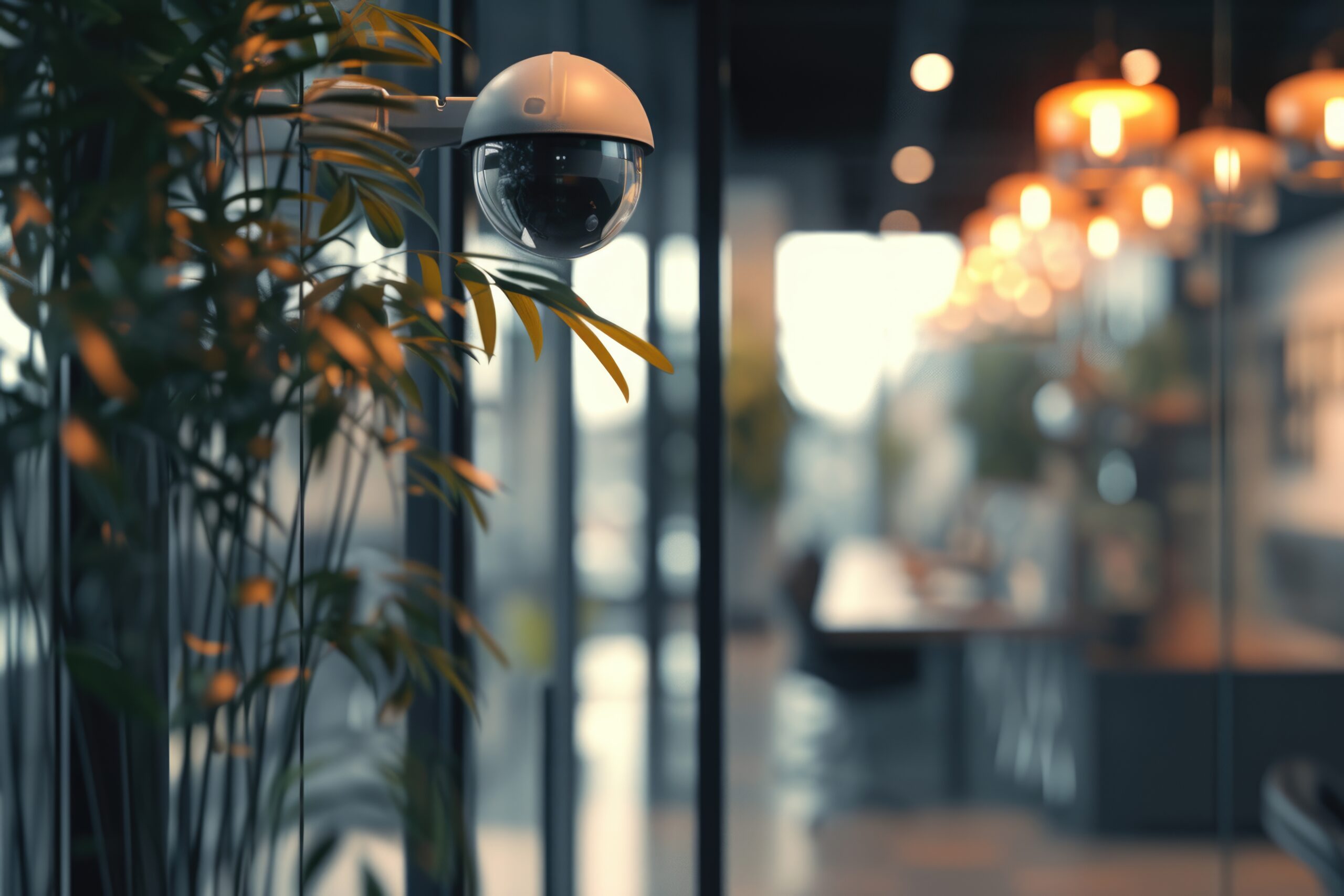


A restaurant has a demanding security routine: daily opening and closing, staff shifts, supplier deliveries, cash-handling areas, stock rooms, secondary doors and long periods when the premises may be completely empty. For that reason, a restaurant alarm should not be treated as a generic off-the-shelf kit. It should be designed around the actual weak points and operating pattern of the premises.
Vian Segur installs business alarm systems in Madrid with professional configuration, Alarm Receiving Centre (ARC) connection, remote management and the option to integrate CCTV cameras, dual communication, wired systems and additional security measures when the risk justifies them. The aim is to protect the business effectively outside trading hours while keeping the system practical for everyday use.
What a restaurant security system should protect
Restaurants combine public-facing areas with working spaces and restricted-access zones. The installation should distinguish between these areas and prioritise the points where an intrusion or unauthorised access could have the greatest impact. The main door matters, but it is rarely the only place that needs protection.
Entrances, shutters and secondary doors
The main entrance, external shutter, rear doors, service exits and supplier access points should all be assessed individually. Hospitality premises often have routes that are used continuously during service but become vulnerable after closing. Detection should cover these points without making authorised staff access unnecessarily difficult.
Windows opening onto courtyards, access from car parks, stock-room doors and connections to shared building areas may also need attention. A zoned design makes it possible to adapt arming to different parts of the premises instead of relying on a single detection point.
Cash areas, tills and office space
Till areas, offices, spaces used for documents and points where management equipment is concentrated deserve specific consideration. It is not always a matter of installing more hardware; it is about identifying where value is concentrated and what route an unauthorised person would most likely take.
Well-positioned internal detectors complement door and window protection. If the first barrier is breached, the system can still detect movement through strategic areas of the premises.
Storage, cold rooms and service areas
Stock rooms, supply rooms, technical spaces and delivery areas may be away from customer view and can sometimes have their own external access. These areas usually need a focus on doors, internal routes and possible connections to the outside. Device selection and positioning should also take environmental conditions and the restaurant workflow into account.
Intrusion security should not be confused with the restaurant’s other technical systems. Each system has a specific purpose and should only be integrated when it is compatible and genuinely useful.
How to choose a restaurant alarm for the way the premises are used
The right system depends less on floor area than on how the restaurant operates. Two premises of similar size can require very different installations if one has a terrace and rear service door while the other sits inside a managed shopping centre with controlled access.
Premises that remain empty overnight
When the restaurant is empty for long periods, communication continuity becomes particularly important. An ARC-connected alarm allows signals to be monitored and managed according to the contracted service. A dual communication alarm also reduces reliance on a single connection, helping the system continue to send alerts if one path fails.
Vian Segur states that its alarm systems use dual GSM/LAN communication. This approach is designed to keep communications available during internet failures, network incidents or certain sabotage attempts, which is especially relevant for businesses that remain closed for many hours.
Restaurants with terraces, patios or auxiliary entrances
A courtyard, independent terrace entrance or service door can increase the area that needs to be assessed. In these situations it may be worth considering whether protection should be limited to the interior or whether earlier detection around certain external points can add value. Outdoor detection must be configured carefully to avoid unnecessary alerts caused by normal movement, vegetation or authorised access.
Businesses with deliveries, suppliers and multiple users
Hospitality businesses commonly have different people entering at different times: management, kitchen teams, front-of-house staff, cleaners, maintenance personnel, delivery drivers and suppliers. The system should be easy to arm and disarm and should support an orderly user-management approach. Remote management can make it easier to check system status and receive alerts within the configuration set for the business.
Components that may form part of the installation
A restaurant alarm can combine several technologies, but not every restaurant needs every component. The correct mix should come from a security assessment so the installation is neither under-specified nor unnecessarily complex.
Intrusion detection and zoning
Indoor detectors and access protection form the basis of many installations. Device positions should reflect real movement routes and vulnerable points rather than simply distributing sensors evenly. Zoning allows the restaurant to protect areas according to different schedules, for example arming a closed stock section while another part of the premises is still being cleaned or prepared.
Dual GSM/LAN communication and ARC connection
Communication is a critical part of the system. Vian Segur alarm installations use dual GSM/LAN channels so alerts can travel by different routes. If one path fails, the other can maintain communication. When the system is connected to an ARC, alarm signals can be received and verified in line with the contracted monitoring service.
Spanish regulations classify connected alarm systems by security grade. Order INT/316/2011 assigns Grade 2 to homes, small establishments, shops and general industrial premises that connect to an alarm receiving centre, while Grade 3 is intended for regulated establishments and other commercial or industrial premises that require a higher level because of their activity or circumstances. The appropriate grade must be assessed for the specific premises.
CCTV for visual verification and supervision
CCTV cameras can complement the alarm by providing visual supervision of entrances, cash areas, corridors, storage and other justified locations. Vian Segur designs, installs and maintains CCTV systems for businesses, including remote viewing options.
Video surveillance in a restaurant must be planned carefully because customers and employees share the premises. The Spanish Data Protection Agency requires cameras to be limited to what is necessary for the security purpose, visible information signs to be displayed and highly private areas such as toilets and changing rooms to remain unmonitored. Recording of public streets and neighbouring spaces must also be minimised.
Wired alarms for stable installations
Where the building infrastructure allows it, wired alarm systems can be a strong option when stability and physical communication between devices are priorities. Vian Segur carries out full or partial wired installations for homes and businesses. In a new restaurant fit-out or refurbishment, planning cabling while other work is taking place can help keep the finished installation discreet.
Security fog for sensitive areas
Some businesses with valuable stock or a risk of fast intrusion may benefit from a security fog alarm. After a valid detection, the system releases dense fog that reduces visibility and limits an intruder’s ability to act. This is not a standard requirement for restaurants and should only be considered where the risk assessment and layout support it.
Comparison of security solutions for restaurants
The table below summarises the role of the main options and when they may be worth considering. It does not replace a technical assessment, but it shows why restaurant security is often built in layers.
| Solution | Main role | When to consider it |
|---|---|---|
| Intrusion detection | Detect unauthorised entry or movement. | Core layer for most installations. |
| Dual GSM/LAN | Maintain communication if one path fails. | Businesses where alert continuity matters. |
| ARC connection | Professional reception and handling of alarm signals. | Premises left empty or needing monitored response. |
| CCTV | Visual supervision and incident verification. | Entrances, tills, storage and justified sensitive zones. |
| Wired alarm | Stable physical communication between devices. | Refurbishments, planned cabling or demanding installations. |
| Security fog | Reduce intruder visibility after valid detection. | Sensitive assets or fast-intrusion risk. |
| Grade 3 | Meet higher technical security requirements. | Only where the activity or circumstances require it. |
Security while the restaurant is open and after closing
Security should not be designed only for the hours when the premises are empty. During service there is constant movement, doors are opened repeatedly and different areas may change status throughout the day. A clear zoning and user strategy helps the security system follow these operational changes.
At closing time, the procedure should be simple: check the defined access points, leave the required areas ready for arming and avoid complicated steps that increase the risk of human error. A professional installation should fit naturally into the closing routine. The easier the system is to use correctly, the more reliable the daily security process becomes.
Remote management can help authorised users check system status, receive alerts and control selected functions from a mobile device. Vian Segur presents this capability as part of its alarm solutions for homes and businesses.
CCTV in restaurants: basic privacy and placement criteria
Installing CCTV does not mean recording every corner. The principle should be proportionality: monitor only the areas that are necessary for security and avoid excessive surveillance of customers or employees. In practice, entrances, cash points, stock rooms and critical circulation routes usually have a clearer security purpose than placing cameras throughout a dining room without a defined need.
The Spanish Data Protection Agency requires visible signage informing people that video surveillance is in use and additional privacy information to be available. Cameras must not capture toilets, changing rooms or similar private spaces, and public streets should only be included to the minimum extent that is unavoidable for the security purpose. If cameras are also used for employee monitoring, specific information duties apply.
These rules do not prevent CCTV from being used in a restaurant. They require it to be designed proportionately. A well-planned system can strengthen security and provide useful incident verification without becoming intrusive.
Does a restaurant need a Grade 3 alarm?
Not simply because it is a restaurant. Spanish alarm regulations distinguish between general commercial premises connected to an alarm receiving centre and establishments that are legally required to have a higher security level. Order INT/316/2011 places homes, small establishments, shops and general industrial premises connected to a receiving centre in Grade 2, while Grade 3 is intended for regulated establishments and commercial or industrial premises where the activity or circumstances demand more.
The decision should therefore come from the business activity, premises characteristics and applicable obligations rather than from a marketing label. If the restaurant is part of a site with special requirements or combines its activity with another regulated service, a specific technical assessment is advisable.
What Vian Segur assesses before installation
Vian Segur describes its approach as starting with a prior assessment of the property. In a restaurant, this should include the number of entrances, staff routes, opening hours, areas that close earlier than others, the location of tills, storage rooms, technical areas and the network infrastructure available for communications.
- Main entrances, rear doors, windows and external shutters.
- Opening, closing, cleaning, delivery and supplier schedules.
- Areas containing cash, equipment, documents or sensitive stock.
- Need for CCTV and proportionate camera placement.
- LAN availability, mobile coverage and the dual-communication strategy.
- Whether full, partial or mixed cabling is appropriate for the existing infrastructure.
- Whether additional measures such as security fog or a higher alarm grade are genuinely required.
The system is then designed around the devices that provide a clear function and the positions where they add value. Good security is not about maximising the number of sensors; it is about making every component work together as part of a coherent design.
Benefits of a restaurant alarm designed to fit the premises
- Protection based on real entrances, cash areas, storage and movement routes.
- Simpler management for teams working different shifts.
- ARC monitoring when this service is included in the installation.
- Communication continuity through dual-path systems.
- The option to integrate CCTV for visual verification and remote supervision.
- Scalability to add wired systems, security fog or a higher grade if the business requirements change.
- Planned maintenance to check devices, communications and configuration.
A properly configured installation can also reduce operating errors and unnecessary alarms by adapting zones, timings and permissions to the way the restaurant actually works. Security is most effective when the system supports the business rather than forcing the business to work around a fixed package.
Maintenance and day-to-day management
A restaurant alarm needs periodic checks. Detectors, communications, cameras, recorders, batteries and system configuration can all require inspection to maintain expected performance. Vian Segur states that, after installation, a technician is assigned for annual maintenance and to handle technical requirements.
The system should also be reviewed when the restaurant layout changes, a door is replaced, the stock room is enlarged, the till area is moved or a new access point is created. A security design based on the previous layout may no longer cover the same risks after a refurbishment.
For daily operation, authorised users and contact details should be kept up to date, opening and closing procedures should be clear and any change that could affect sensors, cameras or communication routes should be reported.
Frequently asked questions about restaurant alarm systems
What is the best alarm system for a restaurant?
The best system is the one designed around the premises, access points, opening hours, sensitive areas and daily workflow. A typical professional design may combine door protection, indoor detection, reliable communication and, where useful, CCTV and ARC monitoring.
Should a restaurant alarm be connected to an ARC?
It can be especially useful when the premises remain empty for long periods or when professional monitoring of alarm signals is required. The service should be configured according to the real needs of the business.
What happens if the internet connection fails?
A dual-communication solution can keep alerts available through an alternative channel. Vian Segur uses GSM/LAN communication to reduce dependence on a single path.
Can CCTV cameras be installed inside a restaurant?
Yes, provided the video surveillance system complies with data-protection rules. Only necessary cameras should be installed, visible information signs must be displayed and toilets, changing rooms and unnecessary views of public or third-party spaces must be avoided.
Do all restaurants need a Grade 3 alarm?
No. Grade 3 is intended for regulated establishments or premises that are required to meet a higher level because of their activity or circumstances. Each restaurant should be assessed to determine the grade and configuration that apply to its specific case.
How much does a restaurant alarm cost?
Cost depends on floor area, number of access points, detectors, cameras, communication method, cabling, ARC connection, maintenance and any additional measures. A prior security assessment is the most reliable way to build an appropriate quotation rather than starting from a standard kit.
Request a security assessment for your restaurant
If you are considering a restaurant alarm, Vian Segur can assess the premises and propose a system tailored to its entrances, opening hours, vulnerable areas and communication needs. You can review the business alarm solutions or request contact through the We’ll call you page.